MemoFix Reviews: Does It Actually Work?
Does MemoFix actually work?
MemoFix uses cognitive-support ingredients with real human research behind them, and its honest advantage is a fully printed label you can verify. Whether it works for you depends on consistent daily use and realistic timelines: L-theanine can help focus within an hour, while bacopa builds memory support over weeks. It supports cognition; it does not treat any condition.
- Fast-acting side: L-theanine (100 mg) for calmer focus, often felt the same day.
- Slow-building side: bacopa monnieri (200 mg) for memory over 8–12 weeks.
- Every amount is printed, so you can check the doses — no pill replaces sleep and exercise.

“Does it actually work?” is the question behind almost every search for MemoFix reviews, and it deserves a real answer rather than a sales pitch or a wall of five-star quotes. So here is how this review is different: we do not publish testimonials or a star rating — we have not collected any, and inventing them would be worthless to you. Instead we do the one thing that predicts whether a supplement can work at all — we map every ingredient in MemoFix to the doses used in published human research, then set honest expectations about how long each one takes. By the end you will know what MemoFix can reasonably do, what it cannot, and whether it is worth your sixty days.
The headline finding, stated up front: MemoFix is built on legitimate cognitive-support ingredients and, unusually for the category, it prints an amount for every one of them. That transparency is its biggest strength. Its doses are a mixed bag against the research — some land in the studied range, one sits below it — but because the numbers are printed, you can judge that trade-off with your eyes open rather than guessing behind a blend.
What is inside MemoFix — the full formula
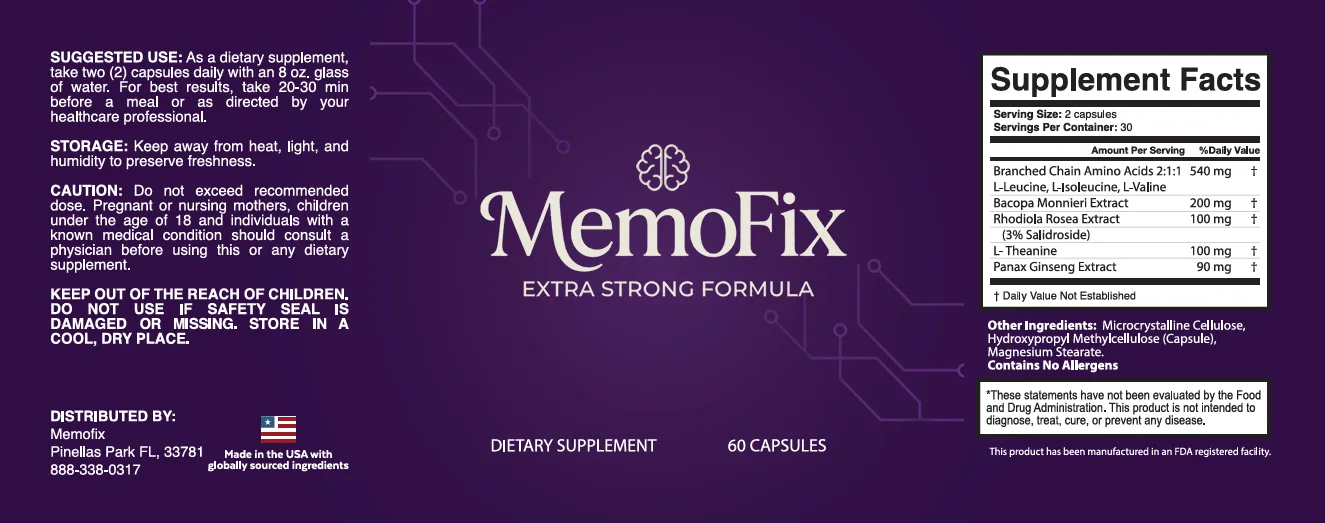
MemoFix is a capsule taken two per day, sixty capsules a bottle, so one bottle is a month. The Supplement Facts panel lists five actives, heaviest-first, with no proprietary blend hiding the split:
- Branched-chain amino acids 2:1:1 — 540 mg (270 mg leucine, 135 mg each isoleucine and valine).
- Bacopa monnieri extract — 200 mg.
- Rhodiola rosea extract — 100 mg, standardised to 3% salidroside.
- L-theanine — 100 mg.
- Panax ginseng extract — 90 mg.
Before we judge whether it works, notice what the label already tells you: every amount is visible. That alone puts MemoFix ahead of the many “brain pills” that hide their doses. If you want the wider context on why that matters so much, our 2026 ranking of the best brain supplements sorts the whole category by exactly this transparency test.
Does MemoFix work? Mapping each ingredient to its research dose
“Does it work” is really five smaller questions — one per ingredient. Here is the honest scorecard against published human dose ranges.
L-theanine (100 mg) — the dose that lands
L-theanine is studied for calm, non-jittery focus, typically in the 100–200 mg range and often paired with caffeine. MemoFix’s 100 mg sits right at the lower end of that studied window, and this is the ingredient most people can actually feel — a smoother, steadier attention that tends to show up within about an hour. On this active, MemoFix is dosed where the research is.
Bacopa monnieri (200 mg) — the honest caveat
Bacopa is the ingredient the memory positioning rests on, and it is the one with the most substantial human evidence for recall. The caveat: memory trials commonly use around 300 mg of a standardised extract, so MemoFix’s 200 mg sits below the typical studied dose. That is not a dealbreaker, and it is not hidden — it is printed, so you can weigh it. It also works slowly: bacopa’s memory benefit builds over eight to twelve weeks, which is central to setting expectations, covered in more depth in our guide to how long nootropics take to work.
Rhodiola rosea (100 mg, 3% salidroside) — standardised but modest
Rhodiola is studied for mental fatigue, and MemoFix does the right thing by printing a standardisation — 3% salidroside on 100 mg is 3 mg of the marker compound. Some fatigue research uses higher amounts, so treat this as a supporting role rather than the star. The standardisation, though, is a genuine mark of quality most labels skip.
Panax ginseng (90 mg) and BCAAs (540 mg) — the supporting cast
Panax ginseng has cognitive research, though often at higher doses than 90 mg, so again a supporting contributor. The branched-chain amino acids are the largest ingredient by weight but are not a classic nootropic; think of them as a general support rather than the reason to buy. Honest framing beats hype here: two ingredients carry most of the cognitive case, and three play backup.
Want to judge MemoFix on your own results?
The doses are printed so you can verify them, and the 60-day money-back guarantee means the only review that counts is the one you write in your own head after a fair trial.
See MemoFix Pricing at the Official StoreHow long does MemoFix take to work? Realistic timelines
The single biggest reason people wrongly conclude a nootropic “doesn’t work” is judging it on the wrong timeline. MemoFix has two clocks running at once.
The fast clock (same day). L-theanine can promote calmer, more even focus within roughly an hour, especially noticeable if your baseline is a bit wired or scattered. This is the effect early takers tend to describe first.
The slow clock (weeks to months). Bacopa’s memory support is a build, not a switch. In studies the recall benefits generally emerge across eight to twelve weeks of consistent daily use. If you take one bottle for three weeks and quit, you have tested the fast clock and abandoned the slow one before it started. This is exactly why the 60-day guarantee is the right length to give the formula a fair trial.
Realistic expectations: what MemoFix will and won’t do
Honesty is the whole point of a useful review, so let us be blunt about the ceiling. MemoFix offers cognitive support — it is not a treatment and does not diagnose, treat, cure or prevent any condition. It will not turn an exhausted, under-slept brain into a sharp one; nothing in a capsule can out-run chronic poor sleep, no movement and unmanaged stress. What a well-dosed nootropic can realistically add is a modest, supportive edge on top of those foundations: steadier focus in the near term, and, with patience, memory support as the bacopa accumulates. Anyone promising a dramatic overnight transformation is selling the promise, not the pharmacology.
Common objections about MemoFix, answered honestly
“There are no customer reviews or star ratings — is that a red flag?” It is the opposite of a red flag here. This site deliberately publishes no testimonials and no star rating because none have been collected, and manufactured reviews are the most common trick in this category. We would rather show you the doses than a wall of invented quotes. If star ratings are what you trust most, that is precisely the habit that gets supplement buyers burned.
“The bacopa is under-dosed, so why consider it at all?” Because you can see the number and decide. A 200 mg printed dose you can evaluate is a better purchase than a mystery amount hidden in a blend, even if that blend claims more on paper. Transparency lets you make the call; concealment makes it for you.
“How does it compare to the big-name brain pills?” Many popular brands lean on blends or single-ingredient stories; MemoFix’s edge is a full open panel with one standardisation. For head-to-head context, our comparisons of Neuriva versus MemoFix and Alpha Brain versus MemoFix weigh the formulas ingredient by ingredient.
How to take MemoFix for the best chance of results
A supplement can only be judged fairly if it is taken properly, and this is where a lot of disappointing self-reviews actually go wrong. A few practical habits stack the odds in your favour. Take the two capsules at the same time each day so you never miss a dose — consistency is the whole game with a slow-building ingredient like bacopa, and a scattered every-other-day routine tests nothing. Take them with food and water; bacopa can occasionally cause mild stomach upset on an empty stomach, and a meal usually settles that. Many people prefer the morning dose because the L-theanine pairs naturally with a morning coffee, giving the calm-focus effect its best-studied context.
Then commit to the full window. Because the memory side of the formula needs eight to twelve weeks to accumulate, the 60-day guarantee is not a marketing flourish — it is roughly the minimum honest trial length. Track something concrete over that period rather than relying on a vague feeling: how often you lose your train of thought, how a specific task feels at 3 p.m., how easily names come back. And keep the foundations in place while you test, because a well-slept, active brain is what gives any nootropic something to build on. Taken this way, MemoFix gets a real trial, and you get a real answer.
Is MemoFix worth the money?
Value in this category is not about the lowest sticker price; it is about whether you can verify what you are paying for and get your money back if it disappoints. On both counts MemoFix does well. It starts from $49 a bottle, with lower per-bottle pricing on multi-bottle bundles, and every purchase is covered by a 60-day money-back guarantee. That combination — printed doses plus a real refund window — converts the purchase into a low-risk experiment with a sample size of one: you. Given how much of the market asks you to pay for concealed doses on the strength of anonymous reviews, a formula that shows its numbers and stands behind them is a fair place to run that experiment.
Run the only MemoFix review that matters — yours
Check today’s official-store pricing, verify the printed doses against this review, and use the full 60-day guarantee to test MemoFix on your own memory and focus.
Order MemoFix From the Official StoreFrequently asked questions
Does MemoFix really work for memory and focus?
MemoFix uses ingredients with genuine human research for cognitive support — L-theanine for calm focus and bacopa monnieri for memory over weeks. Whether you notice a difference depends on consistent daily use and realistic expectations. It offers cognitive support; it is not a treatment for any condition, and no supplement replaces sleep and exercise.
How long does MemoFix take to show results?
It varies by ingredient. The L-theanine in MemoFix can promote calmer focus within about an hour, while its bacopa monnieri works on a slower curve, with memory benefits in studies typically appearing over eight to twelve weeks of daily use. Give the full bottle cycle a fair trial before judging it.
Are there any side effects with MemoFix?
The ingredients in MemoFix are generally well tolerated at studied amounts, though bacopa can cause mild digestive upset in some people, which taking it with food often eases. Well tolerated for most is not a guarantee for everyone, so check with a healthcare professional before starting if you take medication or manage a health condition.
Is MemoFix worth the money compared to other brain pills?
MemoFix's main advantage is transparency: it prints an amount for all five actives and a standardisation on one, so you can verify what you are paying for rather than trust a proprietary blend. Starting from $49 a bottle with a 60-day money-back guarantee, it lets you test the formula against your own results at low risk.